

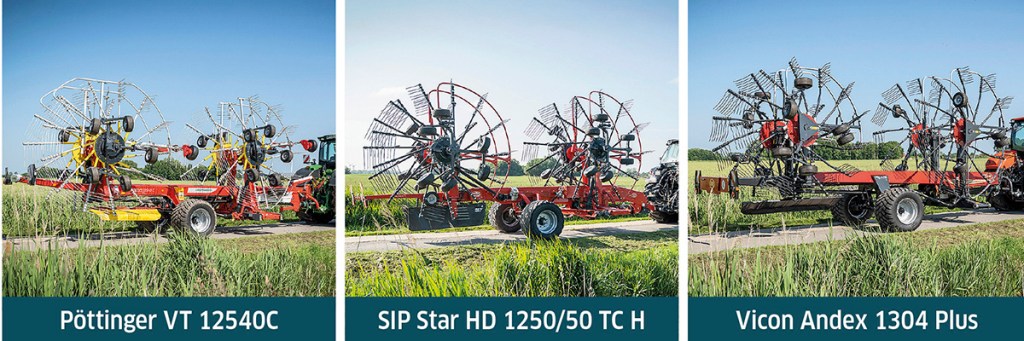
We make our way to the field with our seven simple four-rotor rakes … to see what they are like to use and live with.
KEEPING IT BRIEF
- In the first part of our rake comparison, we did lots of measuring.
- Just how ‘basic’ these entry-level four-rotors are depends on the manufacturer.
- The difference in price was higher than expected.
If you want to extract the best from a machine, it has to be easy to set, adjust and use — and rakes are no different to any other piece of kit on a farm. We took a closer look at the various approaches and solutions on our seven test machines.
Comparable tractor attachment
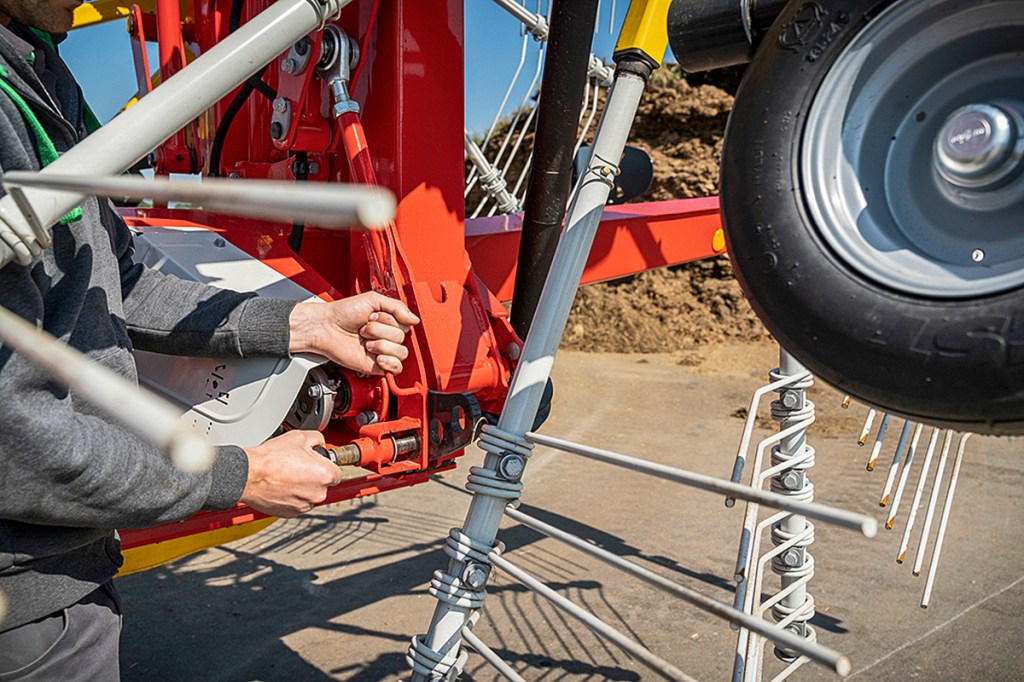
The first thing we looked at is hitching up to the tractor. All seven have parking stands with proper handles and spring-loaded pins, with Fendt being the only exception, instead relying on a traditional pin. Krone uses a double stand, but it doesn’t actually increase the stand footprint. Our team had to unhitch several times on unpaved ground, but none of the rakes sank in.
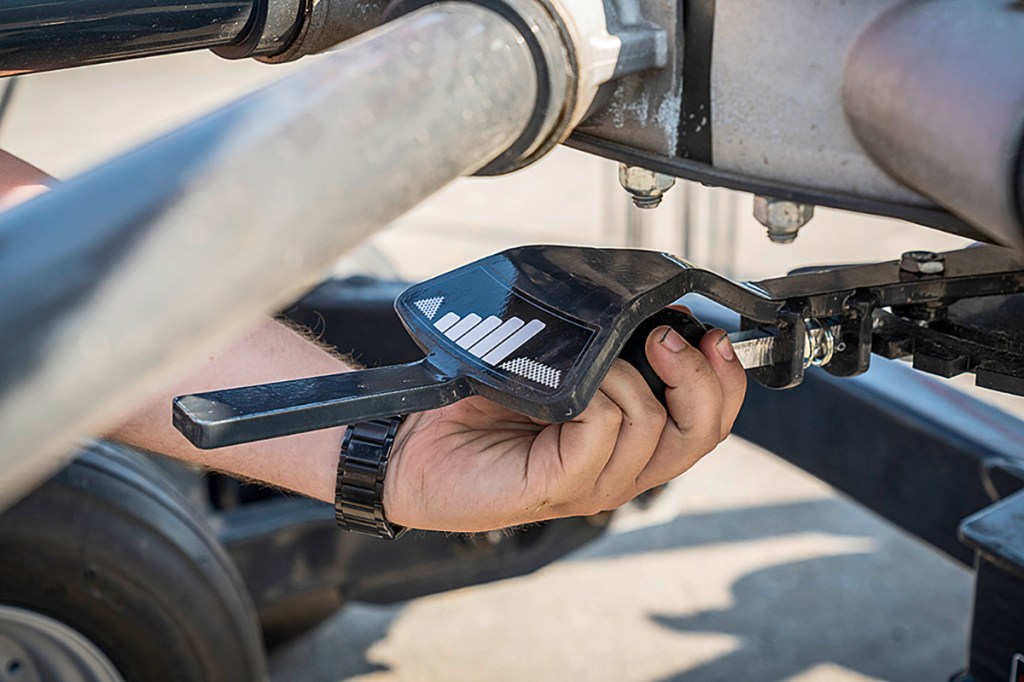
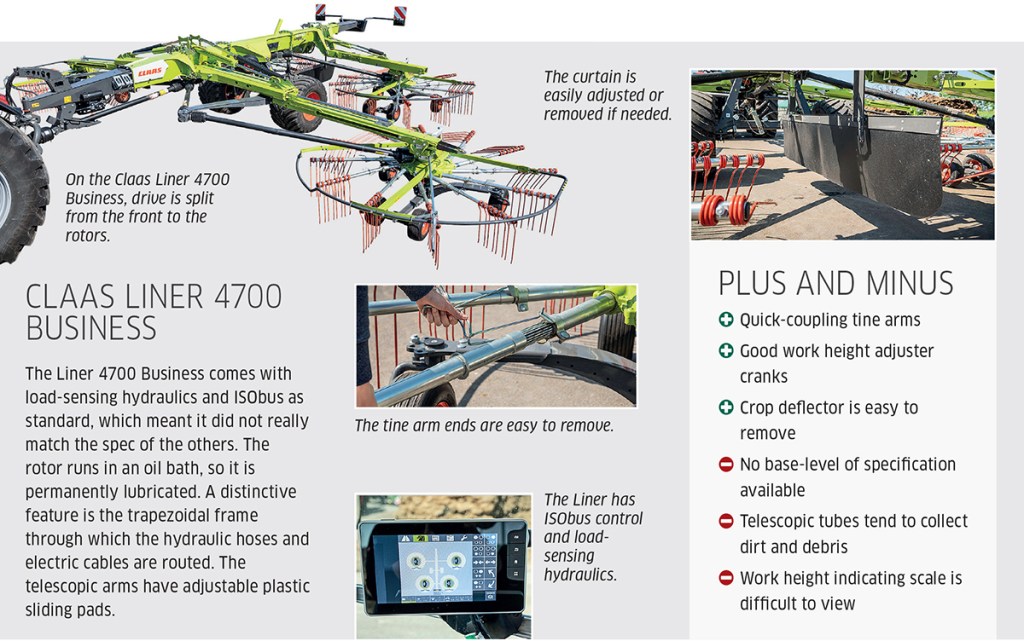
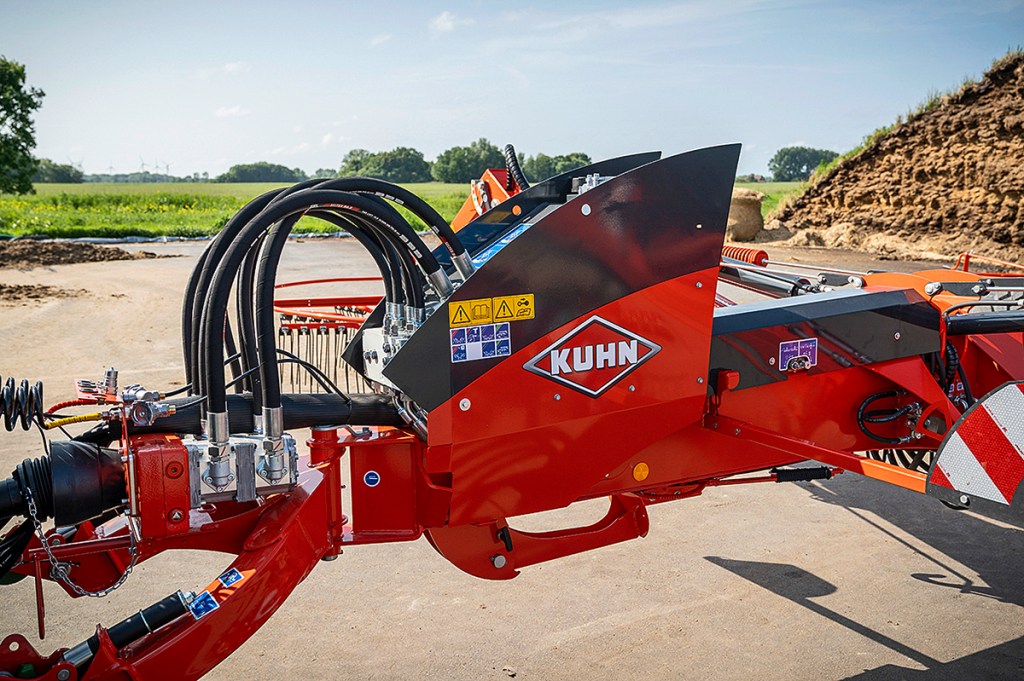
All of them have usable hose holders and cable storage. However, there was a variety of hydraulic connectors employed. Five of the makes simply use the tractor’s spools and a switch box. At the time of the test last season, SIP only had a load-sensing model in its range. The other is Claas, which only uses load-sensing with its four-rotor rakes.
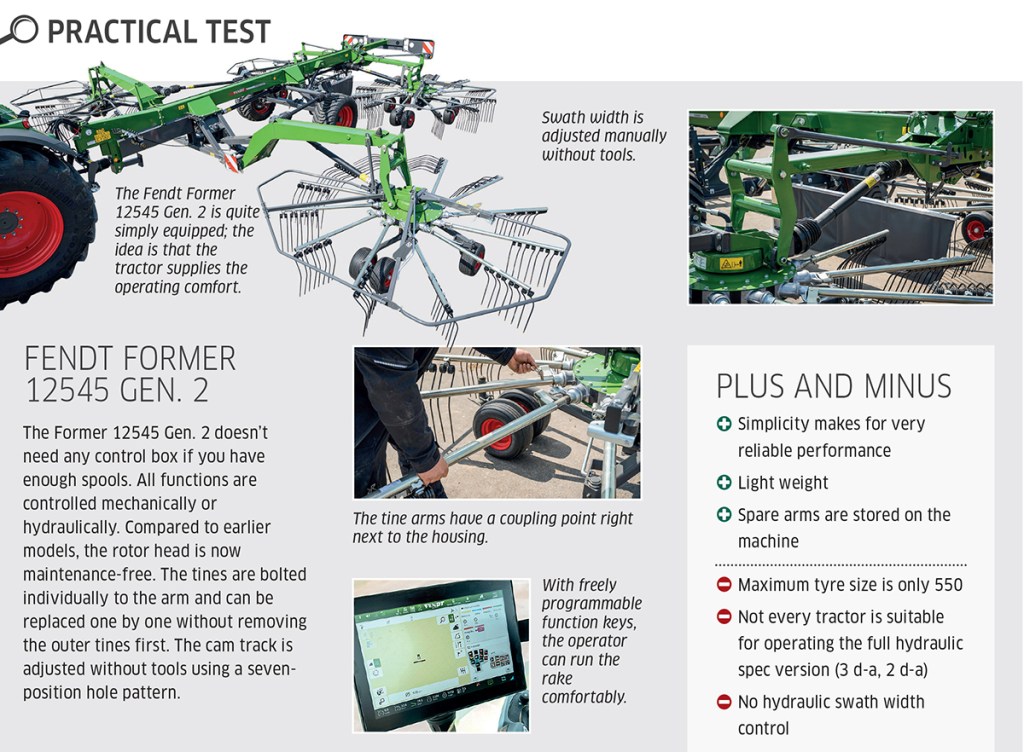
Due to having a couple of options, Fendt fits the most spools (three double- and two single-acting). But if your tractor has enough spool valves, there is no need for a separate control box, with the Former operating much like an ISObus machine.
Fendt can also supply a mechanical sequence control or a switch box, in which case there are just two connections to be made (1 s-a, 2 d-a).
Vicon provides a similarly straightforward solution. All the other rakes needed three spools in the test spec: on some that meant two d-a and one s-a; on others it was the other way round (see the table in Part 1 for more on this).
A look at the control boxes
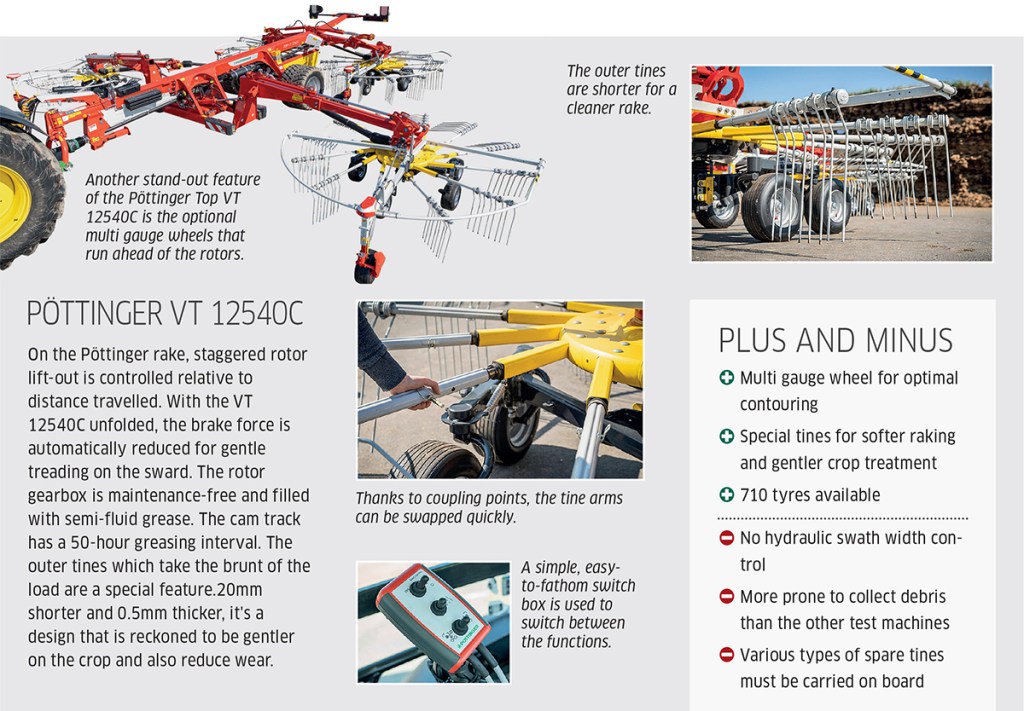
The Pöttinger Top VT 12540C had one of the simplest control boxes, thanks to the swath width being mechanically set using a multi-hole, one-pin arrangement. It’s a genuinely operator-friendly set-up
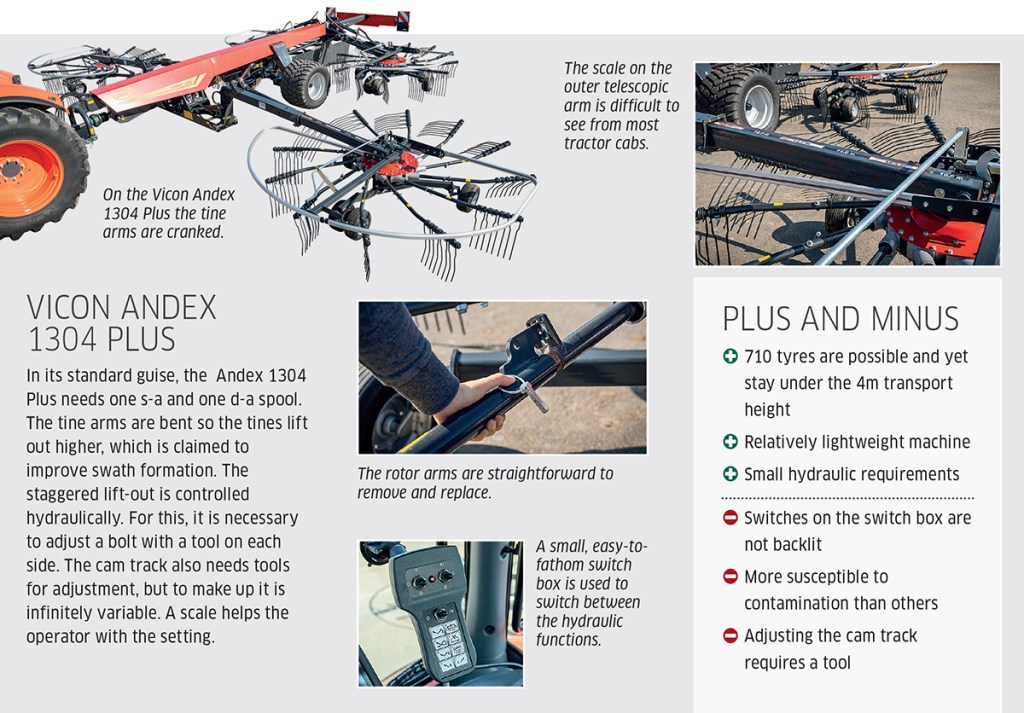
Things get a bit more complex on the Vicon Andex 1304 Plus: it has three multi-way switches whose neat functions are clearly explained by good pictograms.
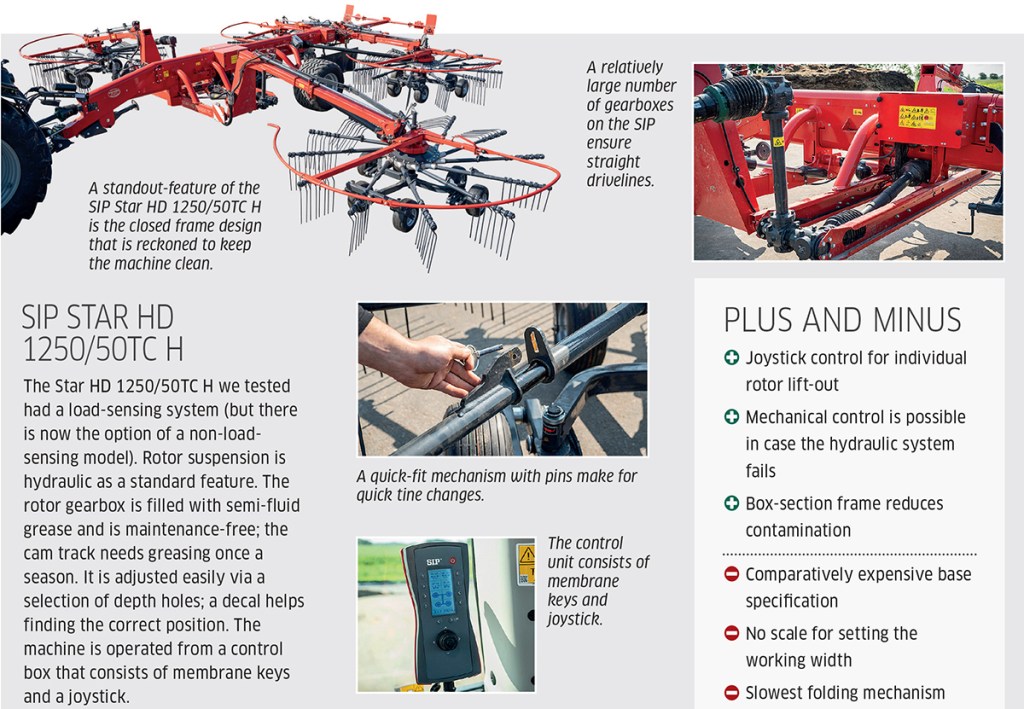
SIP’s Star HD1250/50 also has a slightly more involved control box with a small display and a joystick that lets the operator select and activate the functions.
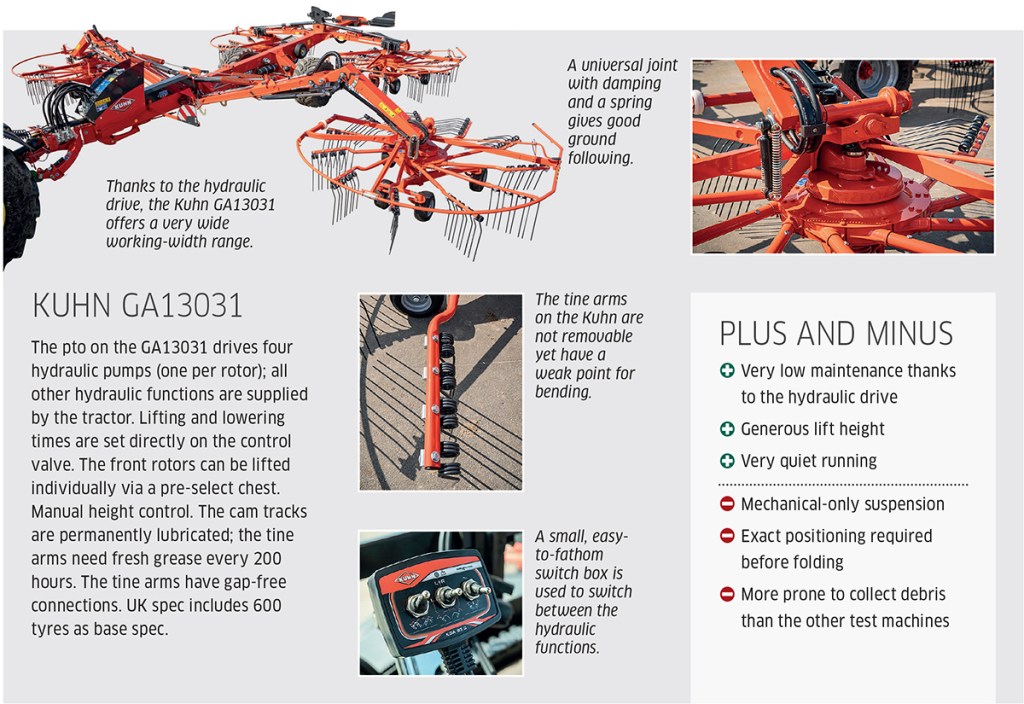
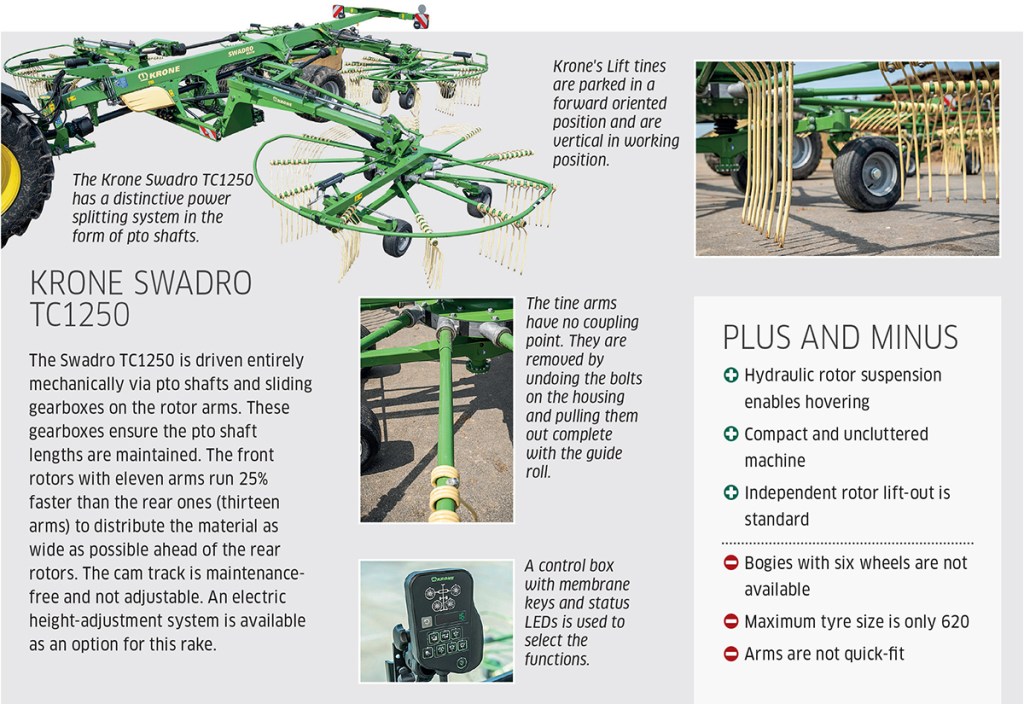
The Kuhn GA13031 rake, too, uses rocker switches, whereas Krone’s Swadro TC1250 has clear, backlit membrane keys for pre-selecting the function. Alternatively, there is an ISObus control option here as well.
The Claas Liner 4700 Business model, with its standard ISObus control, is in a league of its own here.
Setting the raking height
Probably one of the most crucial settings for a clean job is setting the raking height. One of the test machines had hydraulic height control (SIP; a manual version is now also available).
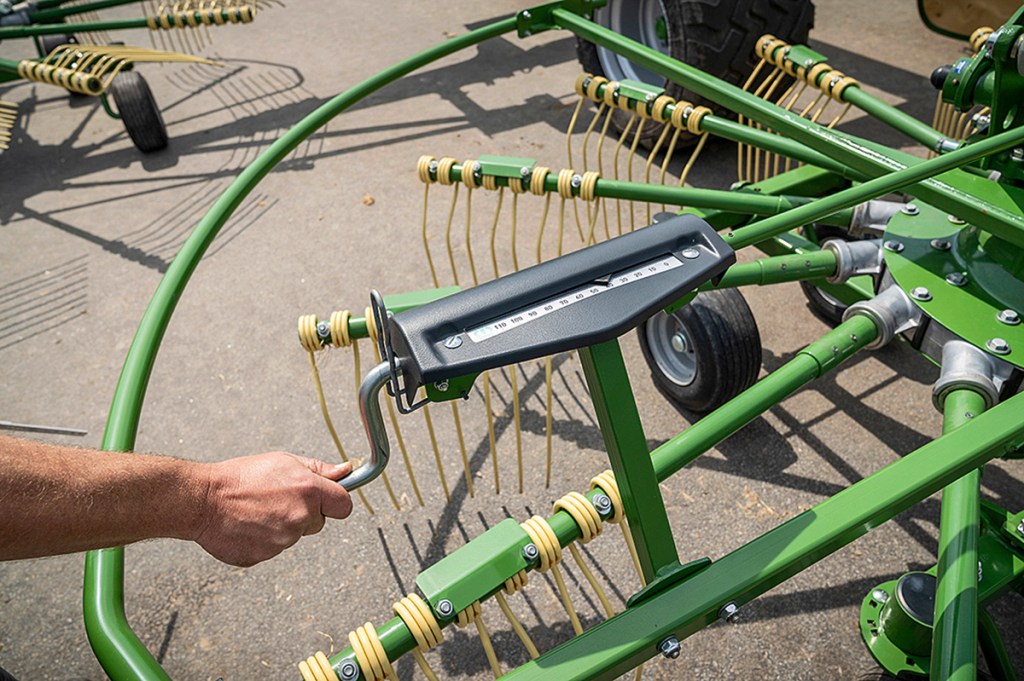
The other six used a mechanical crank. We particularly liked Krone’s solution with the scale on the crank itself in the operator’s line of sight. It has also sussed the positioning of the cranks for safe adjustment — at the front on the front rotors, and to the side on the rear rotors.
Not wanting to teach grandma to suck eggs, but best practice is to not adjust the rotors while the rotors are spinning.
On the Pöttinger, the height is set using a multi-adjustment dial on the front rotor, while on the rear a crank is used to shift this dial adjuster. A clear scale is located on the dials.
Kuhn fits an easily accessible and suitably long crank handle to the sides of the rotors. On the Fendt and Vicon, all rotors have front-mounted crank handles, although on the latter the cranks are too short and a bit of a stretch.
Claas positions the cranks slightly off-centre, though, if the rotors are engaged, you’re still in the danger zone when setting the rear rotor height. But at least the crank handles are long enough.
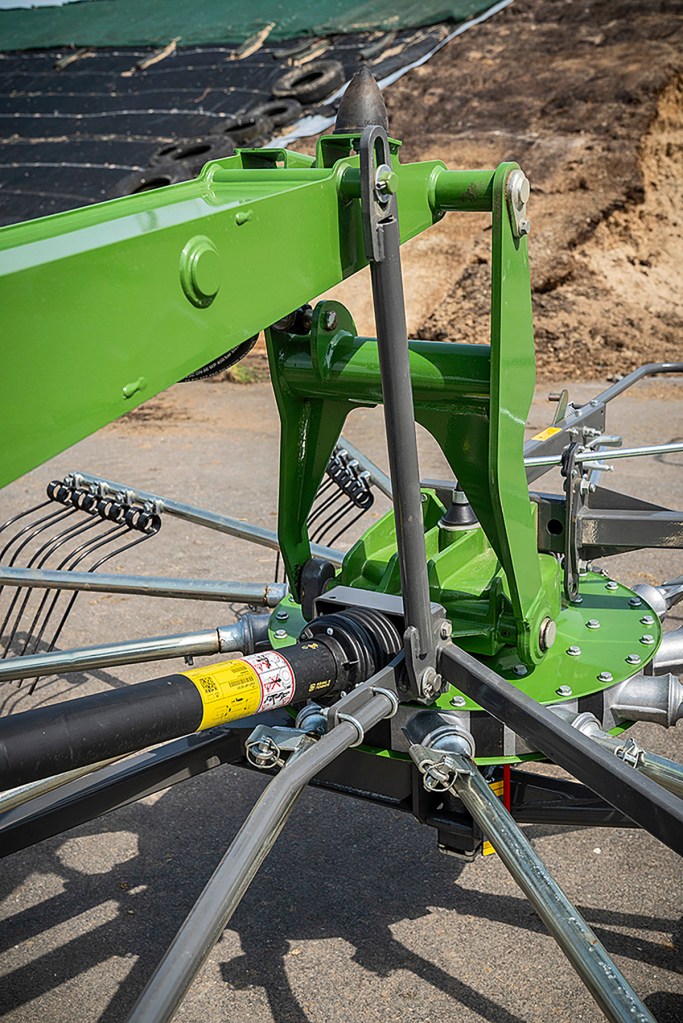
Setting options on the rotors
Each manufacturer has its own approach to adjusting the ground pressure. Fendt does without any suspension courtesy of the rake’s lightweight design, whereas Krone and SIP use a hydraulic pressure relief on all four rotors as standard. Pöttinger and Vicon provide hydraulic suspension at the front and mechanical relief (Pöttinger) or no relief (Vicon) at the rear. Claas and Kuhn go with mechanical suspension on all rotors.
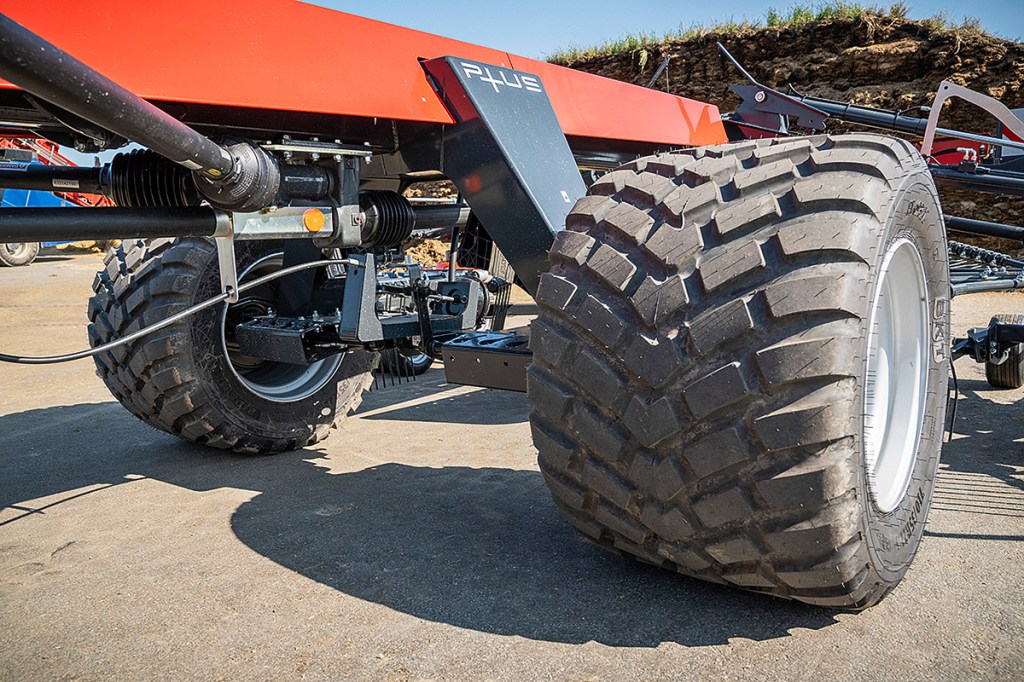
All seven also have individual solutions for aligning the rotors to the ground in/across the direction of travel. Even though these settings are mostly set once and forgotten, it’s still worth looking at the designs: Krone, Pöttinger and Claas operators have bolts in elongated holes while SIP and Fendt users refit shims plus a cotter pin. Such a solution can be altered in the field if necessary.
Vicon has shims on the front rotor wheels and bolts on the back. Kuhn doesn’t have any adjustment options here.
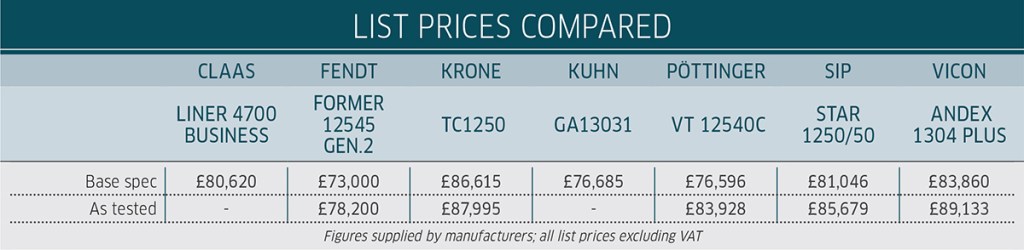
Prices compared
When looking at the models on test, the Vicon has the highest price tag at £89,133. The firm adds that in the UK the ISObus version of the Andex is a better seller.
The cheapest machine in this group in base is the £73k Fendt.. There is not much dividing Pottinger’s VT 12540C (£76,596) with Kuhn’s GA13031 (£76,685).
The higher base spec of UK machines, means, for most, there is not a sizable difference between the off-the shelf machine and the tested version.
Summary
Seven straightforward four-rotor rakes took part in our comparison test. Last month, in profi 4/2026 we focused on the in-work results; in this second part the emphasis is on day-to-day operation, which depends greatly on detail solutions. On the following pages we present the various machines, their features and their pros and cons.
Christian Brüse
For more up-to-date farming news click here and subscribe now to profi and save.