
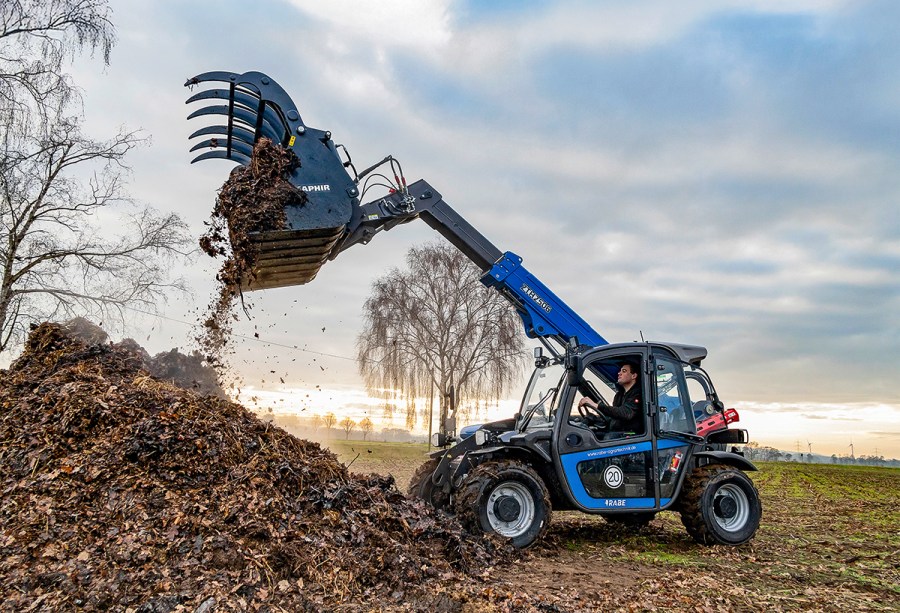
Familiar name, but not in the telehandler game. Zoomlion is looking to make maximum use of the Rabe brand as it enters the world of compact handlers with the ZTH 2506.
KEEPING IT BRIEF
- The ZTH 2506 comes from Rabe’s parent company Zoomlion.
- Despite its compact dimensions, it offers a lift height of 6.10m and can handle 2,500kg.
- Cab and controls are simple, but there’s still a good level of spec
Since 2020, Rabe has been part of the Chinese equipment manufacturing giant Zoomlion. So, at last year’s Agritechnica show, Rabe’s tillage kit had a temporary change of colour, with the tillage kit donning the neon-green to match Zoomlion’s tractors and combines on display. Also on the stand was a little telehandler, the ZTH 2506.
Since the show the Changsha-developed and -built handler has been scrutinised by Rabe engineers at its German headquarters in Bad Essen, Lower Saxony. Reworked from the machine we saw at Agritechnica, it is now hitting the market in the more familiar Rabe blue.
Reaching higher
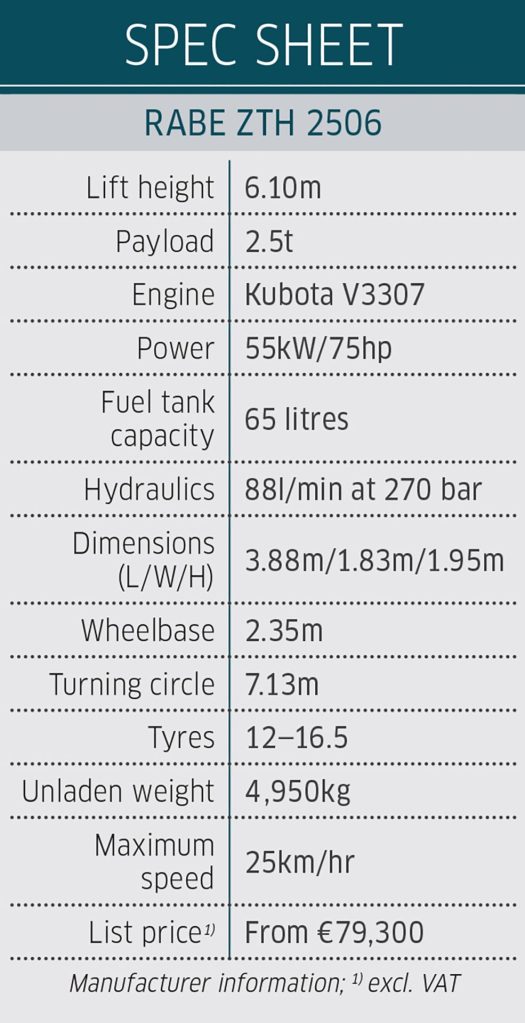
The ZTH 2506 model name logically stands for Zoomlion TeleHandler with a 2.50t lift capacity and 6.00m lift height. Actually, that lift height figure is a tad conservative, as it reaches a lofty 6.10m at the forks, according to the spec sheet. Other critical stats include 1.83m wide and 1.95m high — meaning the small Rabe neatly snuggles into the compact telehandler class.
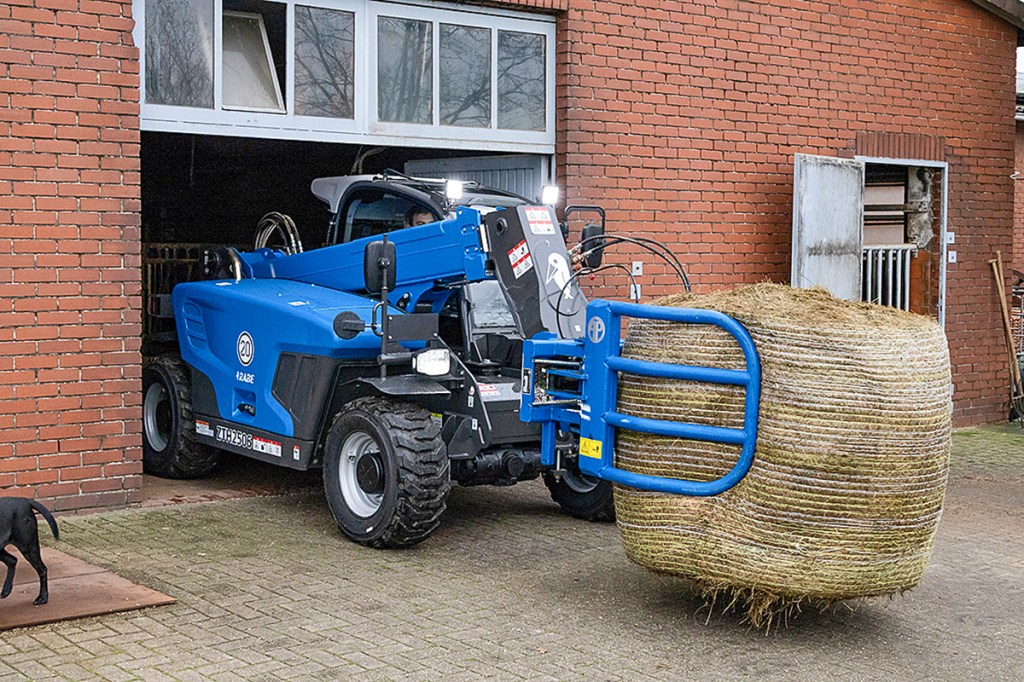
The telescopic boom, constructed from 210 x 230mm rectangular tubing, runs on plastic glide pads but does need greasing. It has hydraulic parallel control along with a boom damping function that can be switched off. According to Rabe, maximum lift capacity is just under 2.60t, and there’s a breakout force of nearly 3,480daN.
The ZTH uses a Euro headstock, which Rabe produces in Bad Essen. A hydraulic locking version is available as an option. All boom pivot points are greaseable and fitted with brass bushes. As yet, there’s no central lube.
Familiar components
Although the ZTH is built in China, it still draws from several well-known component suppliers: power comes from a four-cylinder Kubota Stage V compliant engine with 55kW/ 75hp, while the hydraulics and transmission are taken from Bosch Rexroth and Danfoss, respectively.
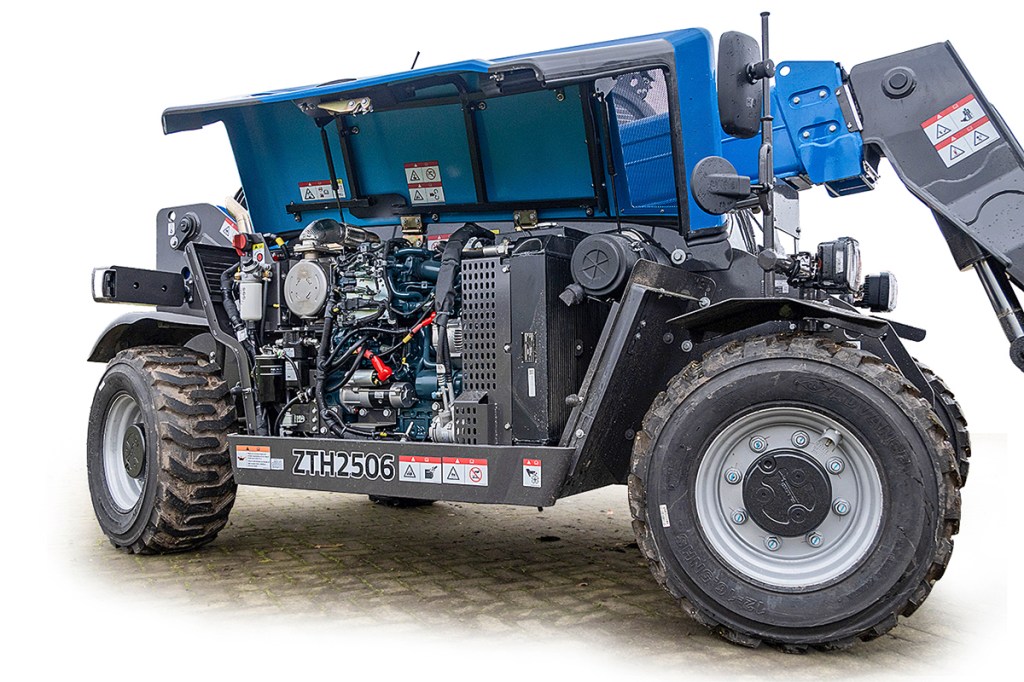
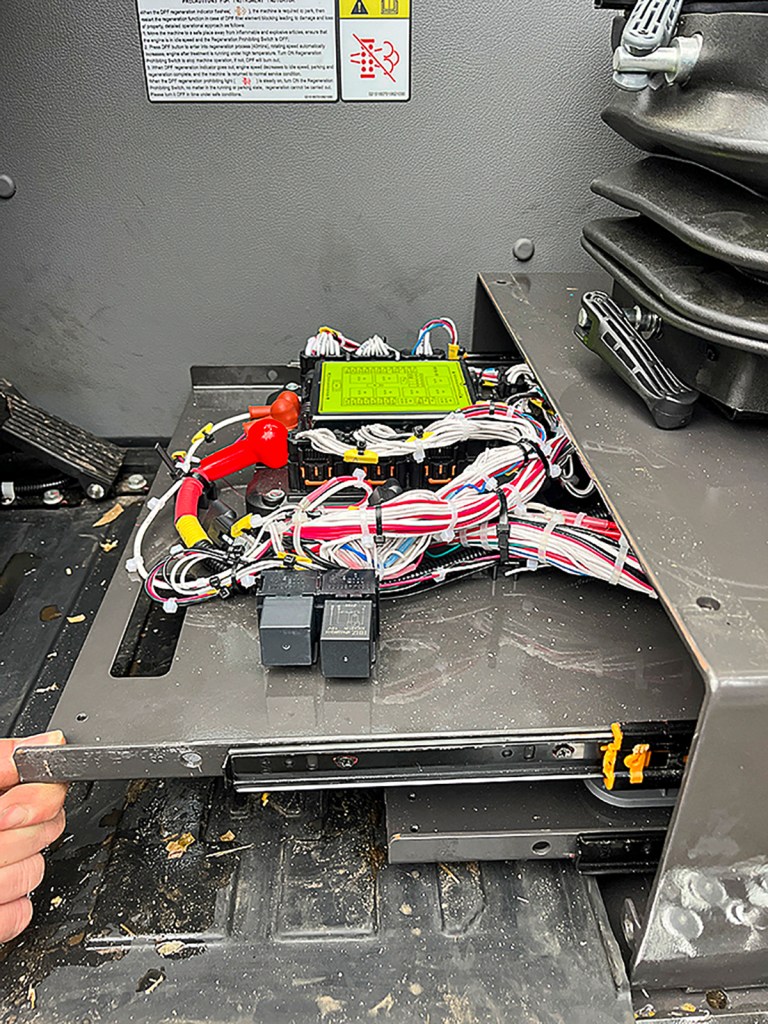
As expected, things are pretty tightly packed under the little blue bonnet (which doesn’t open overly wide), but all of the filters are easy to access. There is no reversible fan option.
On to the compact handler’s transmission, the hydrostat delivers a maximum thrust of 4,200daN. At the press of a button, the operator can switch between two speed ranges of (0-10 and 0-25km/hr). Changing ranges has no real impact on the amount of pushing power, but the slower speed range allows more precise operation. Direction and speed ranges can be changed either on the joystick or via a shuttle lever on the left under the steering wheel. We particularly liked the electric parking brake, which has an auto-release function.
Gear pump for the hydraulics is independent of the transmission and delivers a flow rate of 88l/min at 270 bar. This output is in line with what we would expect for this size of telehandler, but the hydraulics are clearly audible in the cab.
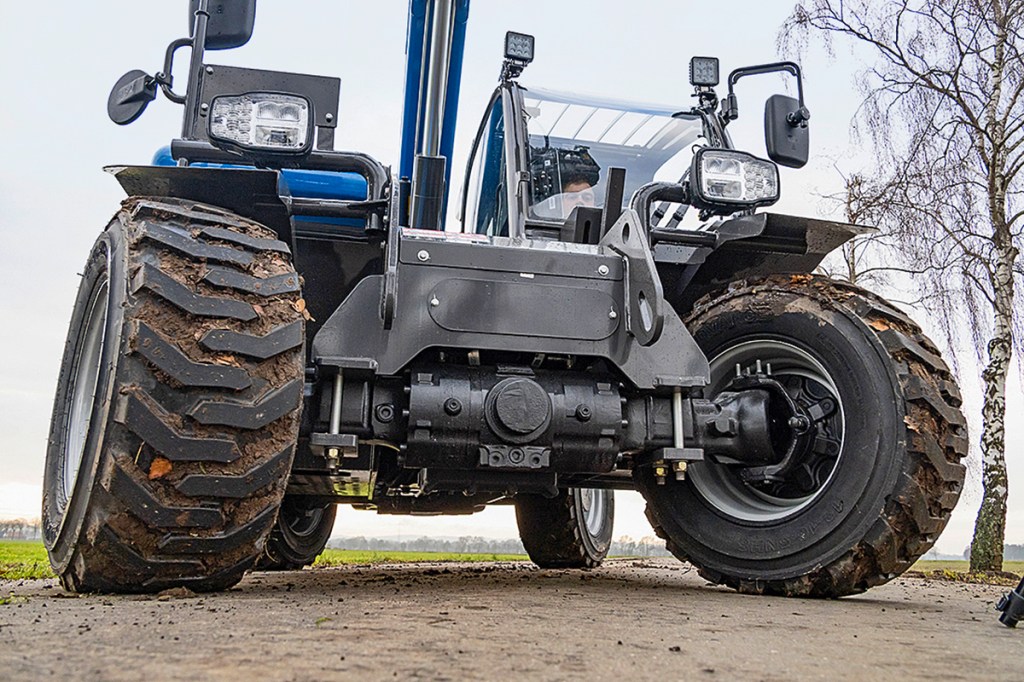
The axles come from Carraro in Italy and are fitted with self-locking diffs front and rear (45% locking effect).
The three ZTH steering modes are selected electronically via a toggle switch and are activated automatically once the wheels have been centred.
Wider cab
Compared to the ZTH 2506 model on show at Agritechnica, the current cab has gained some welcome extra width. We measured 79cm from window to window. The door opens wide, but it doesn’t have a damper. On the plus side, the window can be swung 180° and locked open. The steering wheel also has rake and reach adjustment using two levers. A nice touch is the horn being in the centre of the steering wheel.
The interior has a somewhat rustic feel to it, thanks in part to the array of toggle switches — it left a functional impression during our brief test drive. Once the driver has settled into the mechanically sprung suspended seat, the 10.1-inch display on the right-hand A-post immediately catches the eye. All of the main settings can be carried out on the multi-menu touch screen.
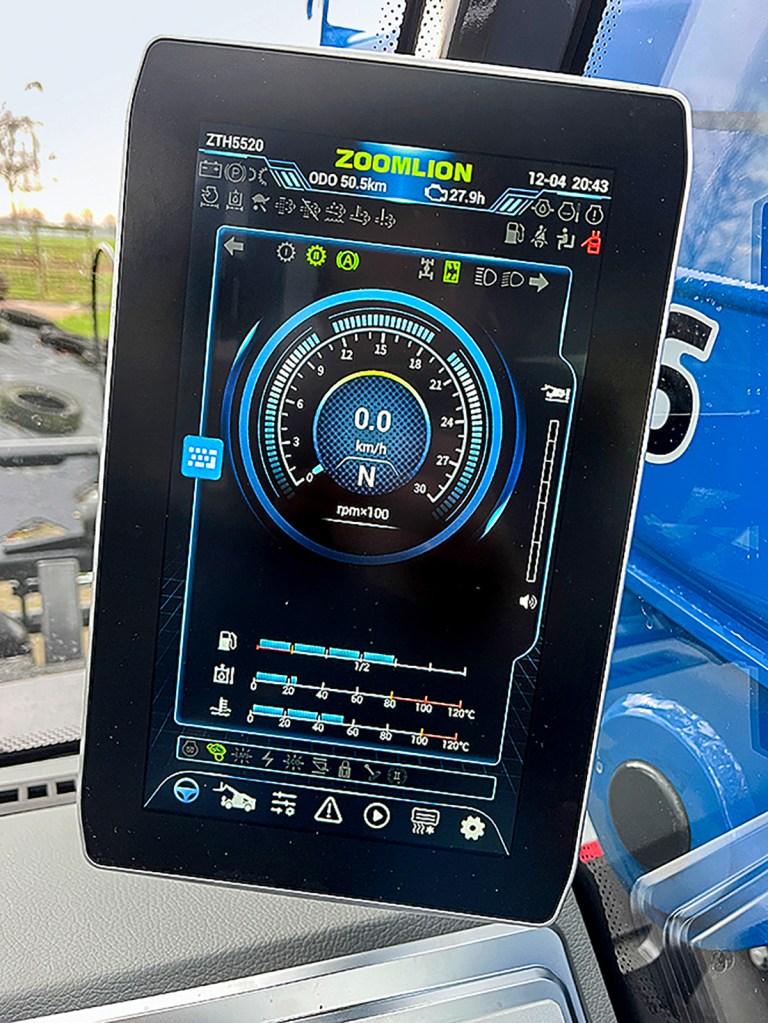
For example, you can enter implement data complete with the appropriate overload setting or operate the radio from here.
The very extensive diagnostic menu is also interesting: alongside the fuse diagram, operator’s manual, parts list and error code list, sensor outputs can also be retrieved from here. Through the handler’s integrated telematics system, the service technician can also view this data. And if the machine is connected up to a Wi-Fi network, the customer can even install software updates themselves.
The simple joystick sits on the right-hand side console, so it doesn’t move with the seat. Rabe tells us that further updates are planned in future, which will also create more storage space.
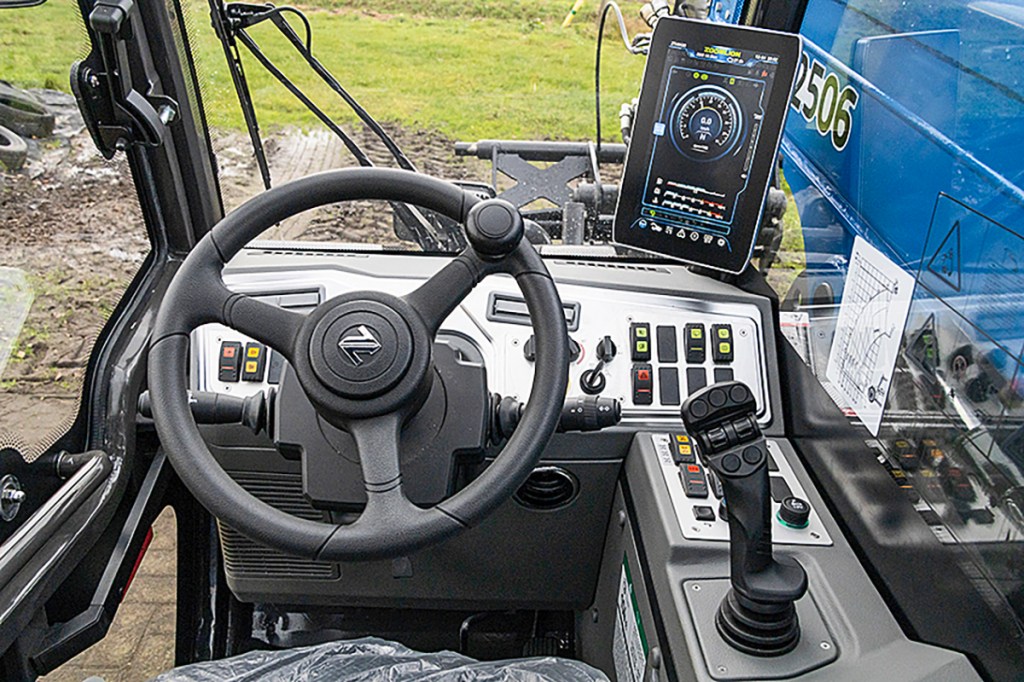
Working with the Rabe telehandler doesn’t exactly feel spacious, but air conditioning and a reversing camera are standard kit. Visibility from the cab is generally good: there are even three wipers (front/rear/roof) and an internal protective grille for the roof window. The grille is slim and set away from the glass, so the panes can still be properly cleaned when they fog up — excellent.
More details
- There is the option of 300/75 R 18 AS-profile tyres.
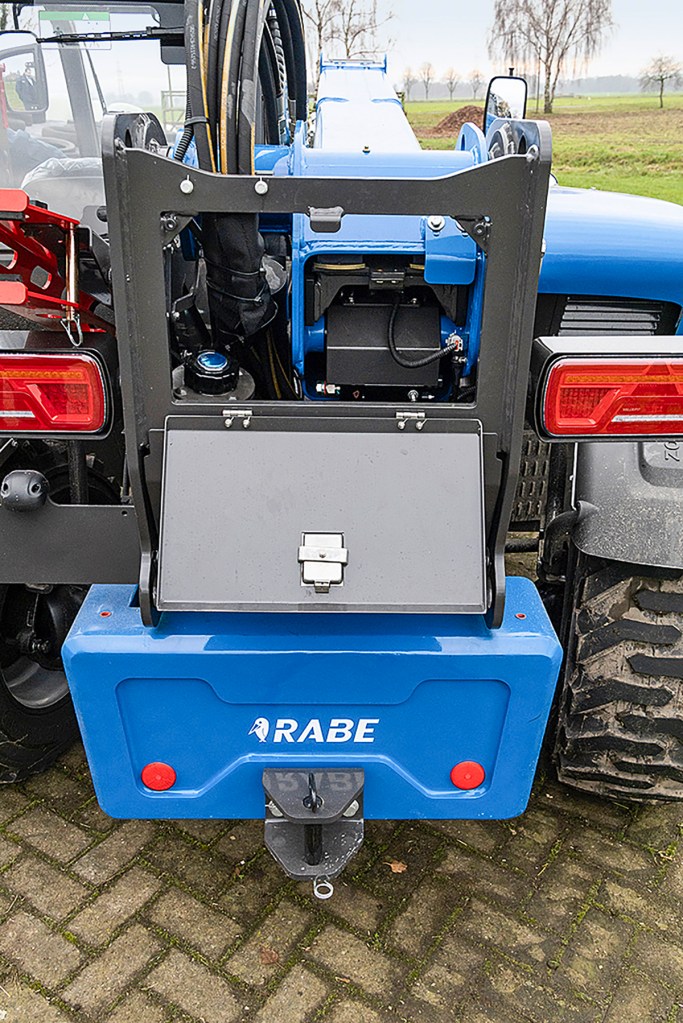
- At the rear, there is a simple shunting hitch, without a hydraulic coupler.
- Overload protection system is triggered by detecting rear axle unloading using strain gauges.
- For the construction industry, the ZTH 2506 will be marketed as a more entry-level Zoomlion in neon green.
Summary
So far, the ZTH 2506 is the first and only telehandler to wear Rabe’s blue livery. And it is not set to be the last, as the larger ZTH 3507 is already undergoing intensive tests to get it ready for the European market — whether we eventually see it and the 2506 in the UK or Ireland has yet to be finalised.
During our brief stint in the seat, the ZTH 2506 made a decent impression — it does what it is supposed to do. The transmission could still be a little smoother, though, and the cab a little quieter.
That leaves the price: the ZTH 2506 we tested, with hydraulic quick attach, is listed at €79,300. This pitches the little handler with the long boom at around €60,000 to the end customer in Germany. In return, you get a nimble loader with suitable equipment. Clearly, only time will tell what the resale value will be like.
Lucas Colsman
For more up-to-date farming news click here and subscribe now to profi and save.