
Given 2026’s bone-dry conditions, it’s no surprise that attention is turning to fire suppression. Norfolk firm LMG Agri has developed a front tank option equipped with pump and hose reel to provide a rapid response option that could save vital minutes before the fire brigade arrives.
KEEPING IT BRIEF
- Product training supplied
- Constant 10 bar working pressure
- Three nozzle choices
Latham Geer’s Sentinel fire suppression unit has been two years in the making. The Norfolk entrepreneur first saw an opportunity to import a cost-effective option from Europe, which turned out to be anything but cost effective.
“I knew from the start that this type of asset protection device needed to be sub-£5,000 to be attractive, and when the import option was around twice that price, I knew I had to source, build and supply locally,” explains Latham Geer of LMG Agri.
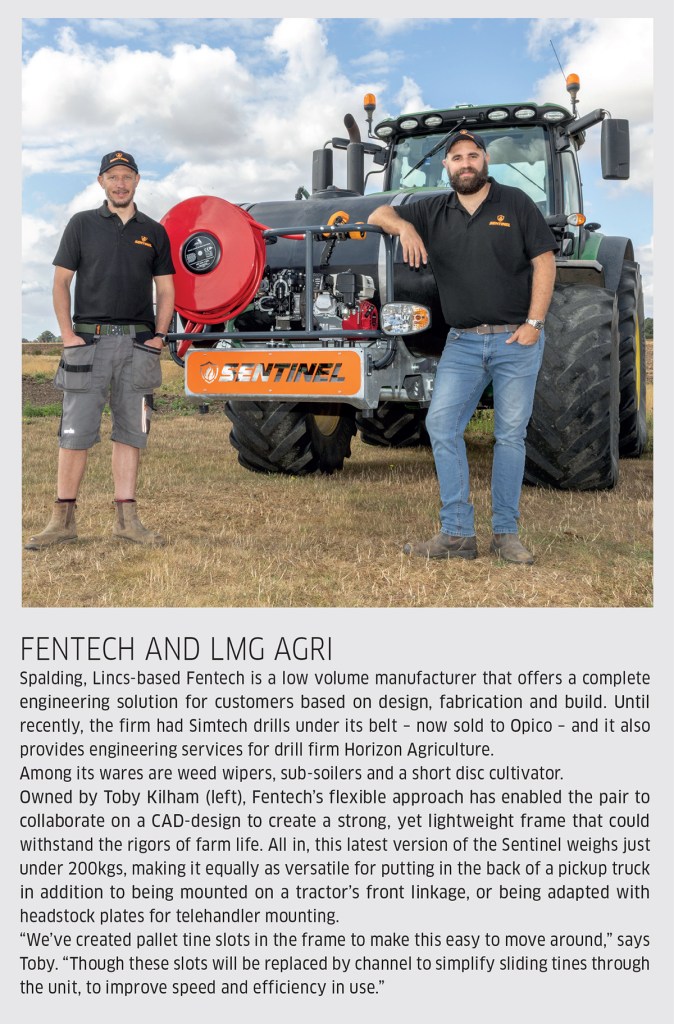
In his quest to find an engineered solution, Latham teamed up with Toby Kilham at Lincs-based Fentech (see, Fentech and LMG Agri for more on that) to design, develop and build the Sentinel fire suppression unit.
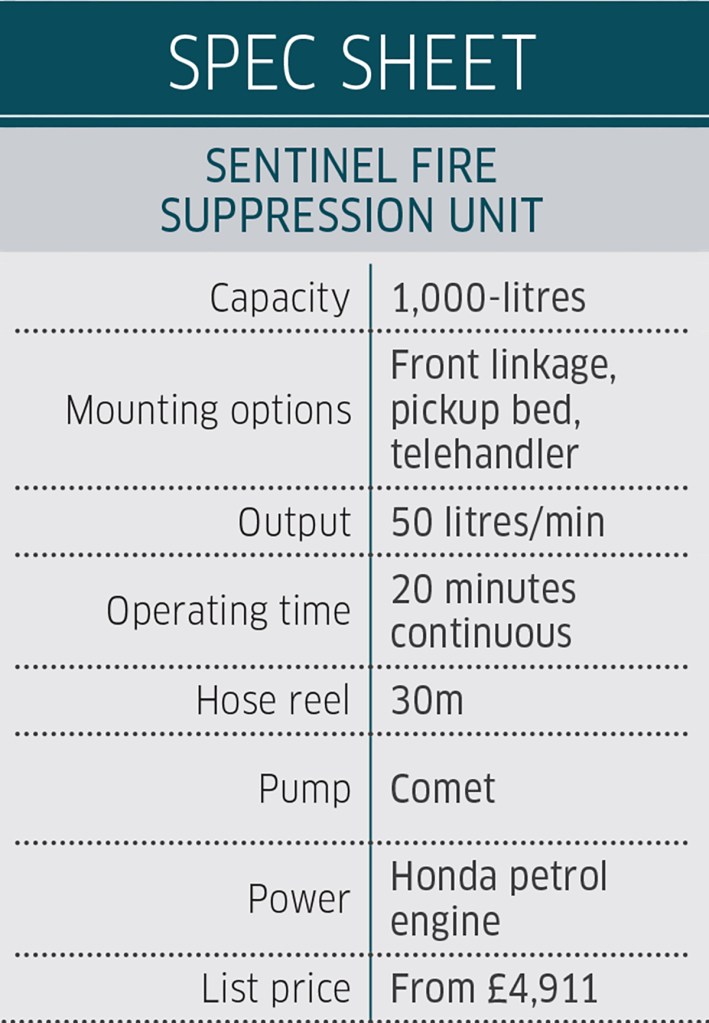
“The challenge was to find a combination of components that could deliver high pressure and low flow,” he explains. “No good having 1,000 litres of water that’s gone in 60 seconds. Our objective was to create a highly effective fire suppression unit that could operate for a minimum of 20 minutes of constant use. It’s a chunk of time that creates a valuable window of control before the fire brigade arrives on-scene.”
This latest version of Sentinel has been through a journey of evolution that has seen different pumps, hose reels, spray guns and frame assemblies put through the mill, in search of an effective package of fire control.
“We’ve spoken with, and sought advice from, the fire brigade, and that’s led us to where we are today,” he adds. “The base package we’ve created starts at £4,911 and specification can be enhanced, to suit a customer’s requirements.”
“The Sentinel has been designed to be more than just a fire suppression unit,” he says. “It could be used as a mobile power washer for in-field cleaning, or used to carry other liquids.”
Front tank
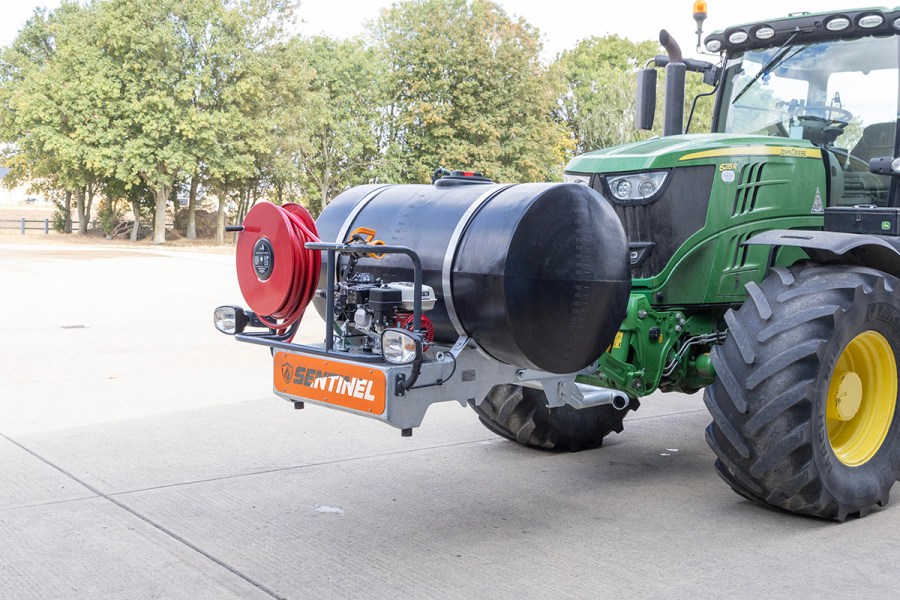
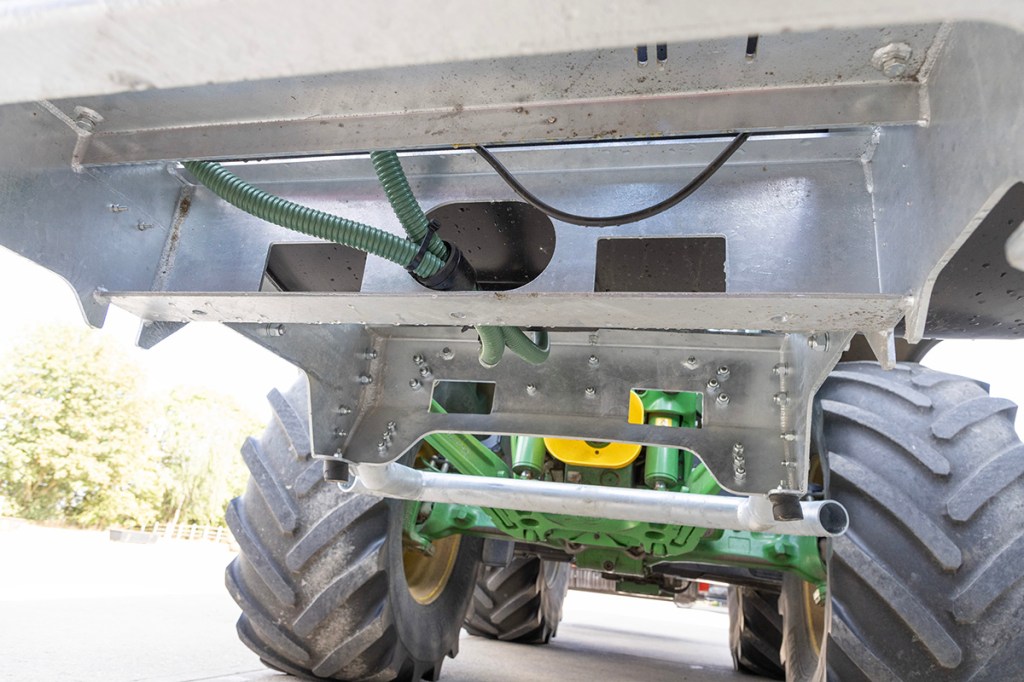
At first glance, you could be forgiven for thinking this is little more than a front tank set-up, similar to what sprayer makers offer. A barrel-shaped 1,000-litre Enduramaxx tank sits on a galvanised frame, with cradling to locate the tank, and steel bands running over the top to secure the plastic tank in place.
Filling the tank is currently through the lid on top, but there are plans to offer a manifold on the front of the frame to simplify this task.
The front-linkage mounted version featured here is modular and features bolt-on plates to enable lower links and a top link to be fitted. A bolt-on tubular bar can eliminate the need for a top link fixing, allowing the weight to be supported under the bottom of the link arms. All are available at extra cost.
Without the bolt-on plates, the unit could be slid into the back of a pickup. And with telehandler headstock plates currently in the works, more versatility is available. The firm says that additional formats are in development, including a pair of 400-litre saddle tanks for fitting to trailer chassis.
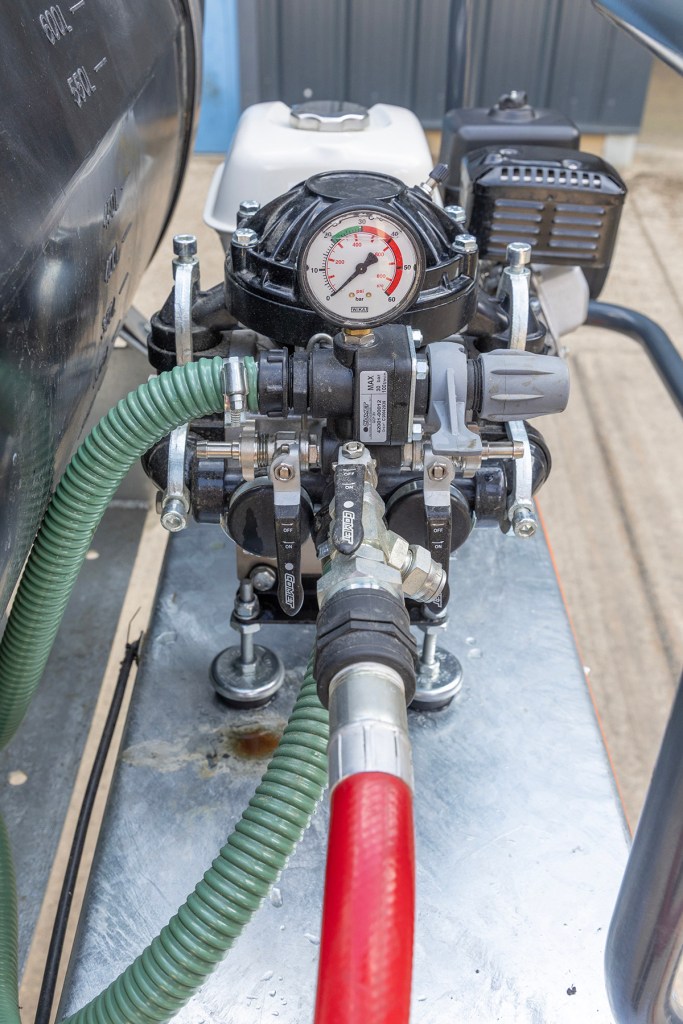
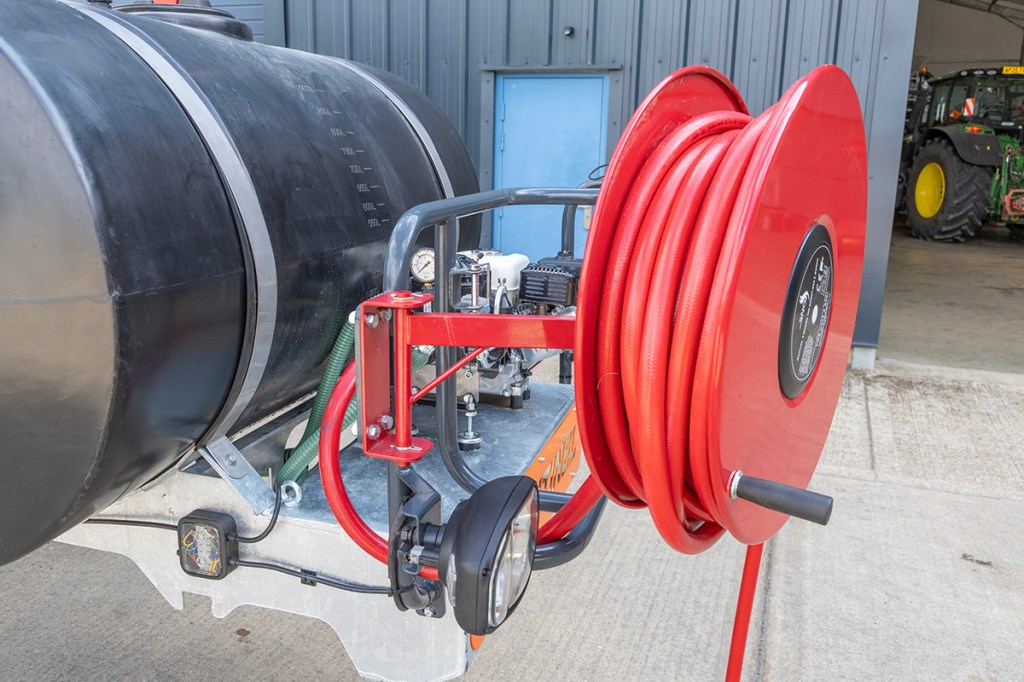
Power for the pump comes from an on-board Honda petrol engine, coupled directly to a Comet pump. The firm did consider hydraulic or front pto power, but if the host tractor is lost, the Sentinel fire suppression unit would be little more than a costly front weight block.
The pull-start petrol engine is mounted on the left-hand side – the same side as exiting the cab door, making it convenient to reach. And that same philosophy has been applied to the stowed position of the spray gun, which can be unclipped and pulled out once the engine has been started.
The Sentinel’s hose reel is a 30m long item, and is mounted on a pivoting arm to simplify pulling out the hose in a 180-degree arc across the front of the frame. And rather than an automated rewind like a workshop airline hose reel, the firm has maintained a simple and lower-cost approach that needs to be wound back in, after use.
Getting the right combination of pump and nozzle has been the biggest challenge, with Latham seeking to achieve 50 litres/min output backed up by a consistent pressure, and three nozzles to choose for the job at hand.
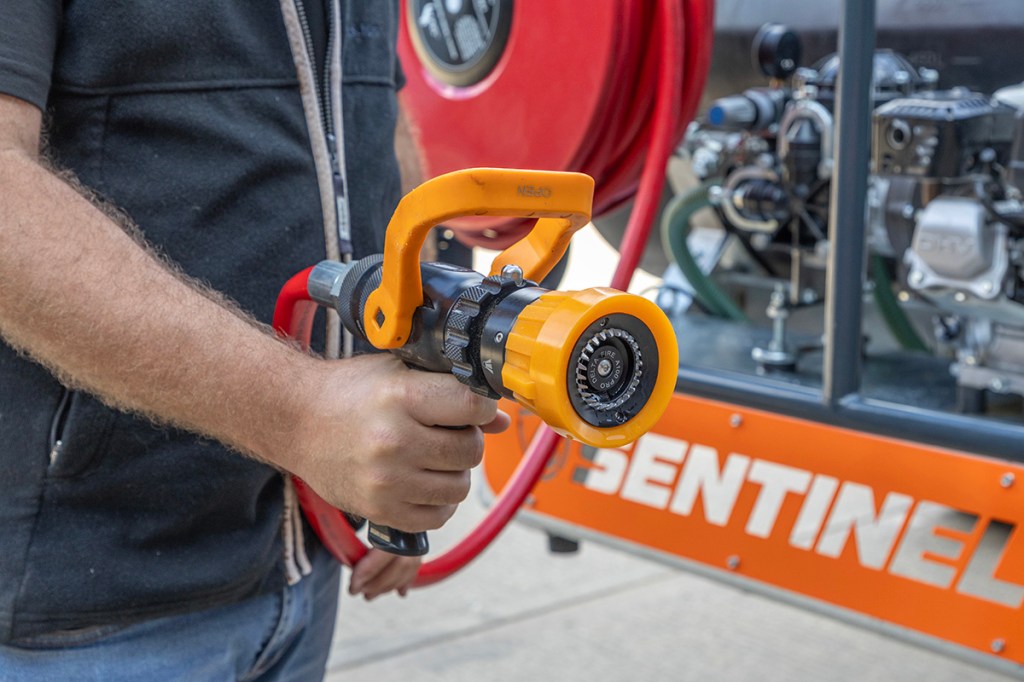
The Delta Fire A100 Pro nozzle on our test version adds £500 to the cost, but it also delivers the best range and soaking capability, making the most of pump flow.
Fireman Geoff
With the hose unwound, and keen to have a go on the nozzle, the Sentinel’s engine is fired into life. Putting one foot in front of the other, and with two hands gripping the nozzle, I brace myself for the surge.
Pressure builds rapidly in the hose and I pull the handle to release the flow, letting 30 bars of maximum pressure erupt in a pencil jet that reaches a distance of 15m. It’s so strong that it could have an unsuspecting operator off their feet, but is effective enough to ensure an operator can remain at a safe distance from a fire.
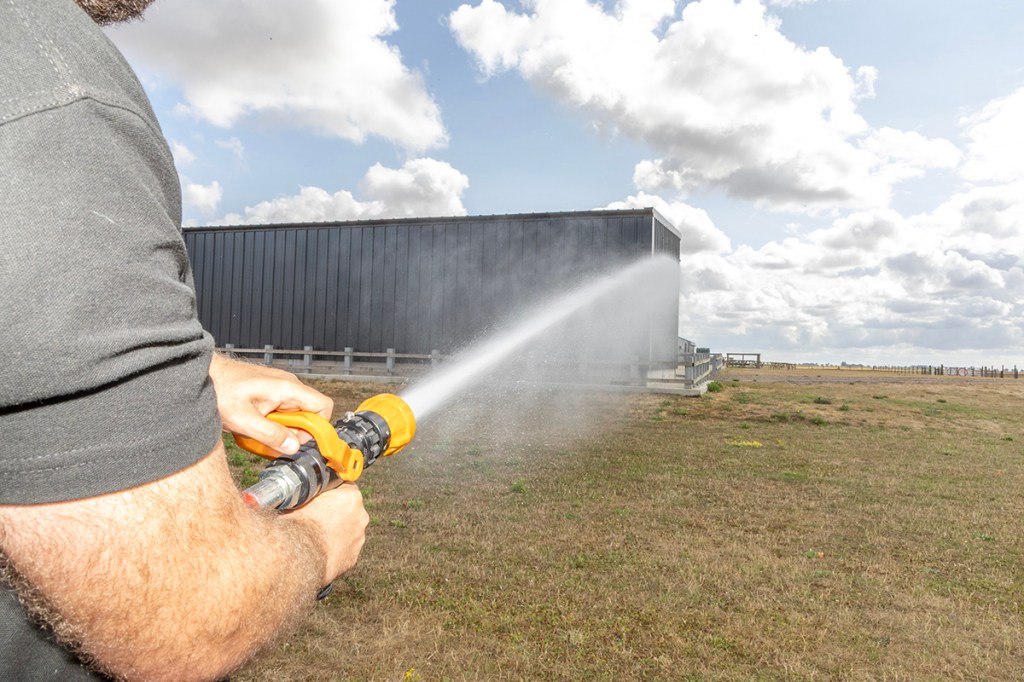
The pump settles to a consistent 10 bar working pressure, maintaining flow without interruption or fade. Twisting the nozzle changes the pattern to a dense fan, offering a 3.0m diameter, 360-degree circular pattern suited to drenching a broader area.
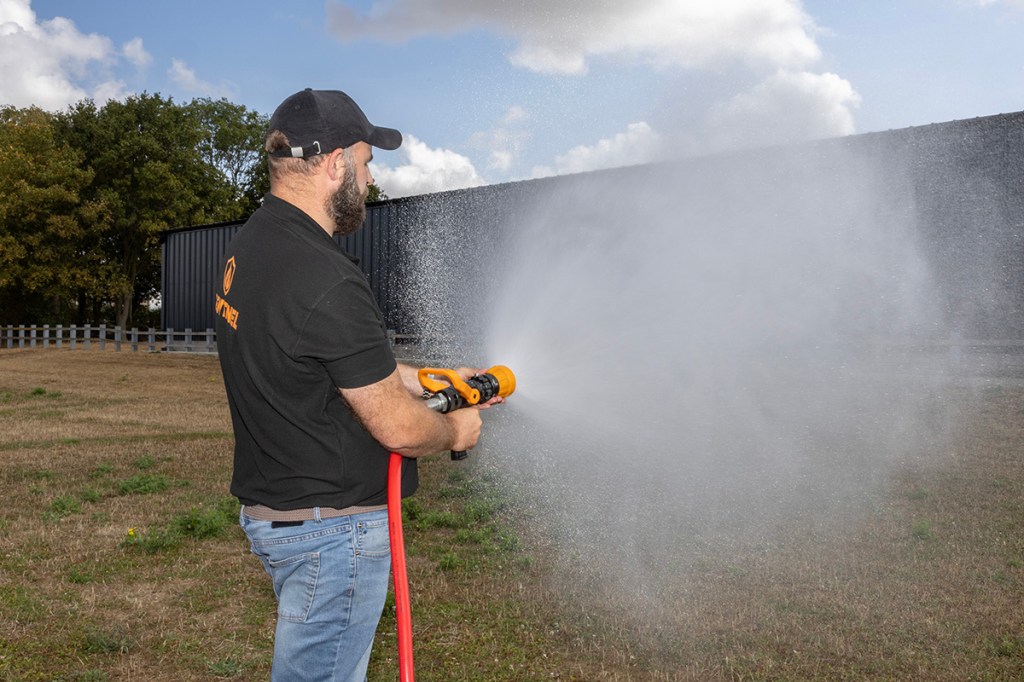
With a flow rate of 50l/min, and 1,000 litres of tank capacity, I’ve got 20 minutes of non-stop fire-fighting capability in my hands. Longer, if the application of water isn’t continuous.
Summary
Given the hot, dry summer just experienced, and the increased risk of fires that came with it, few could dispute the need for greater preparedness and due diligence when operating high value tractors and harvesters in tinder-box conditions. Sentinel is an easy-to-use, mobile solution that can buy valuable time before the fire brigade arrives. Surely it’s only a matter of time before insurance companies insist on having this type of precautionary measure in place.
Geoff Ashcroft
For more up-to-date farming news click here and subscribe now to profi and save.