
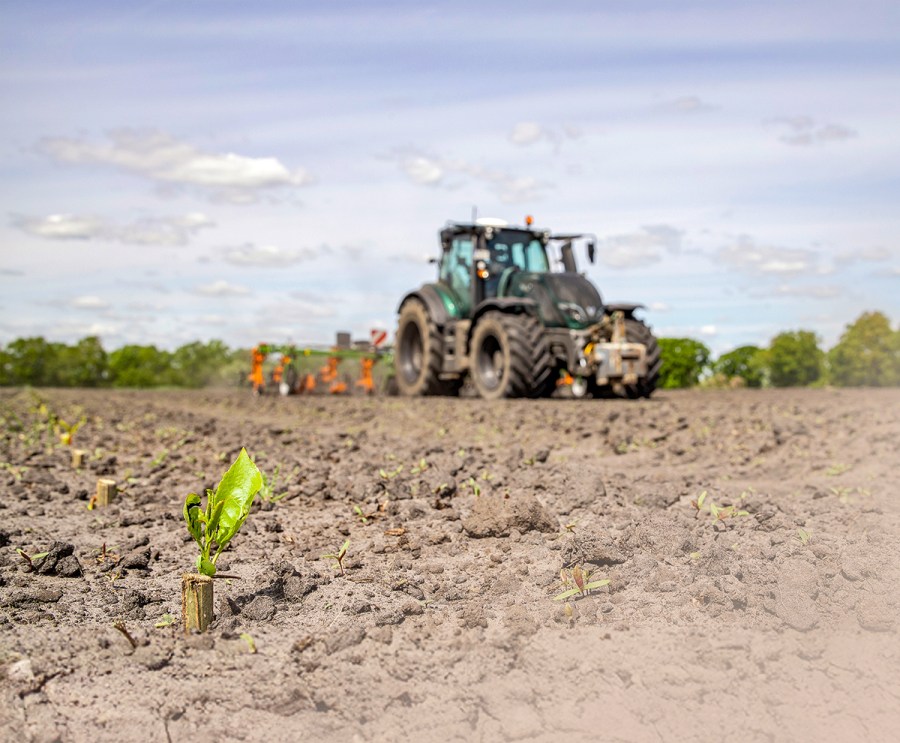
Keeping Berlin warm while being carbon-neutral is an ambitious goal, but local business Energy Crops is helping to make this target a reality. The company specialises in growing poplar trees for biomass.
KEEPING IT BRIEF
- Energy Crops takes care of the cultivation of the short-rotation coppice plantations as well as harvesting and transporting the wood chip.
- Around 2,500 hectares are managed by the company.
- All of the harvested crop goes into heating the city of Berlin.
Heating Berlin using wood chip is a tough ‘ask’ that was never going to happen overnight. Energy Crops was founded back in 2011, and by 2015 had established around 2,000ha of short-rotation coppice (SRC) plantations in the greater Berlin area — enough land to supply the fuel for the first heating power station with 20% SRC wood chips for a trial.
Up to 10t of growth
Over the following years, it hasn’t just been the biomass that has grown … so has the number of orders. Berlin’s coal-fired power stations are gradually being replaced by a number of new technologies. A small portion of the overall generating capacity will be replaced by biomass, including wood chips from SRC.
It usually takes four years for the trees to reach their first harvest, with 20-year long contracts agreed between the landowner and Energy Crops. Main requirements are a minimum soil index score of 20 and access to groundwater. The pH should be 6.0-6.5; otherwise liming is necessary. But there is no need for any fertilising before the crop is planted.
“We estimate an 8-10t increase in dry matter per ha per year,” explains Dustin Kirmis, who is the field manager at Energy Crops and in charge of all land acquisition, growing and harvesting operations. “The first harvest is quite unpredictable, but in the following cuts we harvest between 60t and 80t of fresh matter, which equates to around 40t of dry matter per hectare.” Incidentally, even after a harvest 20 years down the line, the land is meant to keep its arable status.
Only ploughed once
Fields are usually ploughed before planting, then subsoiled with a Brix Rambo to a depth of 45cm, with the crop then planted on the same pre-loosened strips.
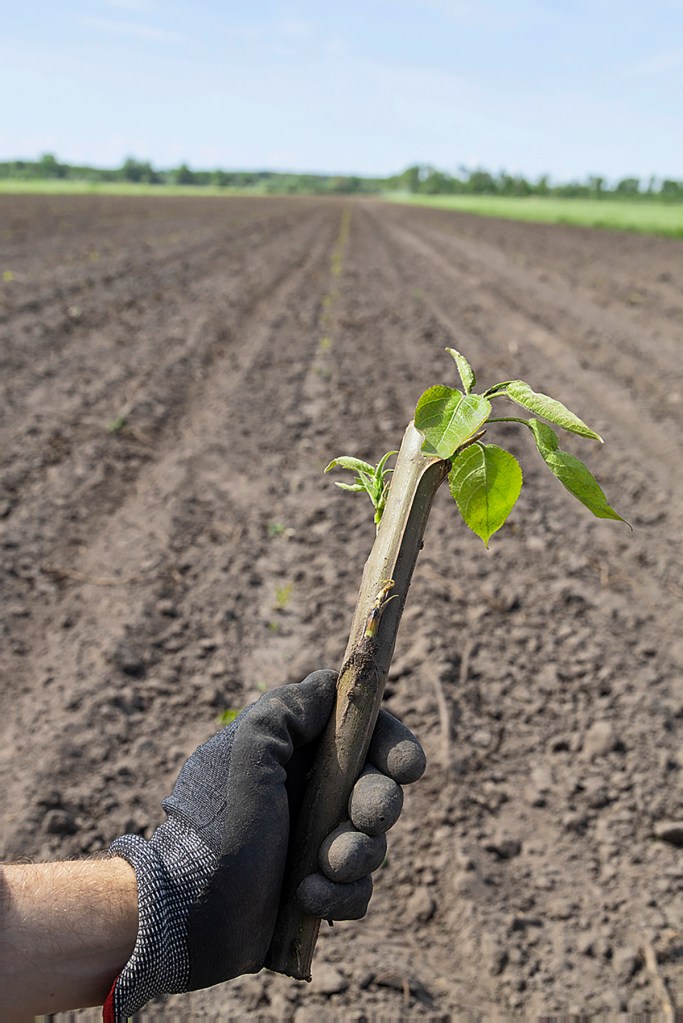
Cuttings of 20cm to 30cm are then usually planted on a 45cm spacing, with the exact length depending on soil type and water availability. Planting contractors raise the cuttings in mother plantations, harvesting them once a year and cutting them into sections. Specialist three-row planters put the new crop in the ground, but the cuttings still need to be positioned into the planter by hand.
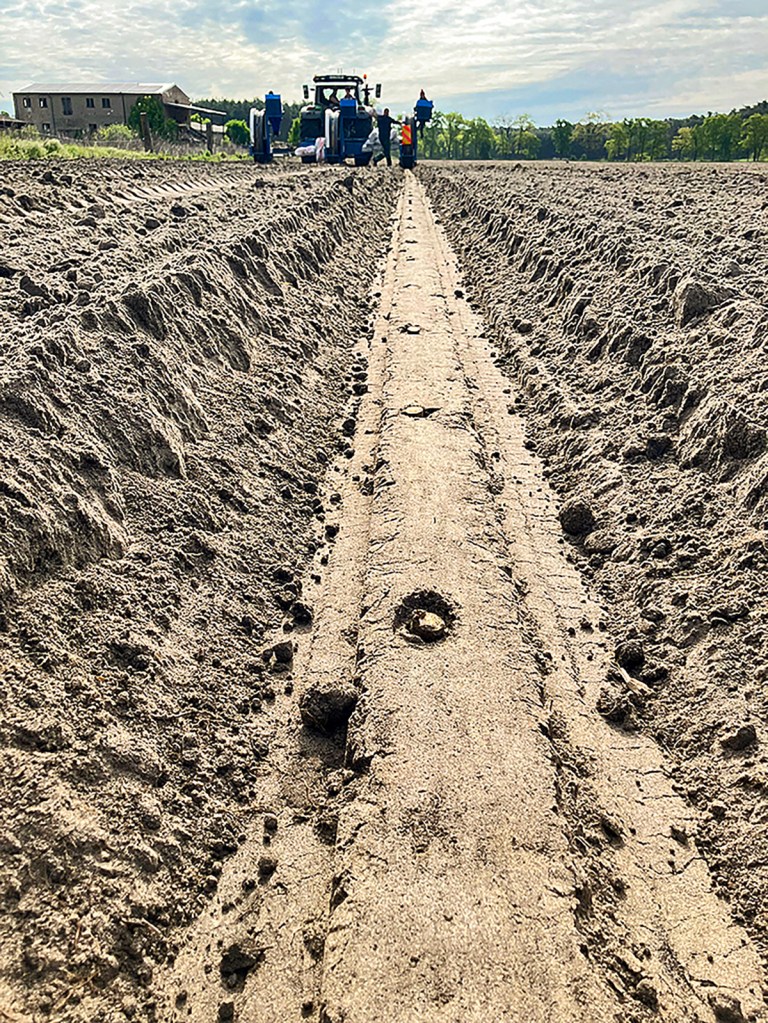
Under an Energy Crops contract, the farmer is still responsible for maintenance work, which also includes keeping an 8m wide headland clear.
Crop care: the tricky bit
Looking after the crop during the first two years is no easy task. Chemical protection is only possible in the pre-emergence stage, with a herbicide usually applied directly after planting.

In Energy Crops’ early days, the strips in between the poplar rows were cultivated two or three times in year one, using a narrow disc harrow. However, it wasn’t very efficient, and very few farms had a suitable tractor. At Agritechnica 2023, Dustin Kirmis went hunting for a better solution, reasoning that if crop hoeing worked for maize and pumpkins, it should work for poplars too, especially because they put down a taproot with few side shoots.
The solution was a 7.20m Amazone Venterra 2K hoe, whose standard working set-up — ten parallelogram sections — is built for nine rows at 75cm spacings. “That means we don’t need a specialist machine, which also helps when it comes to resale,” says Dustin Kirmis.
Like the planter, the hoe covers three rows in one operation. They only need to adjust the tools for the 2.40m row spacing. The machine has a hydraulic side-shift frame (±30cm) and the Horus Professional camera system, although, as Dustin points out, “the camera needs plenty of leaf mass to detect the rows.” That’s why they operate the hoe manually during the first pass.
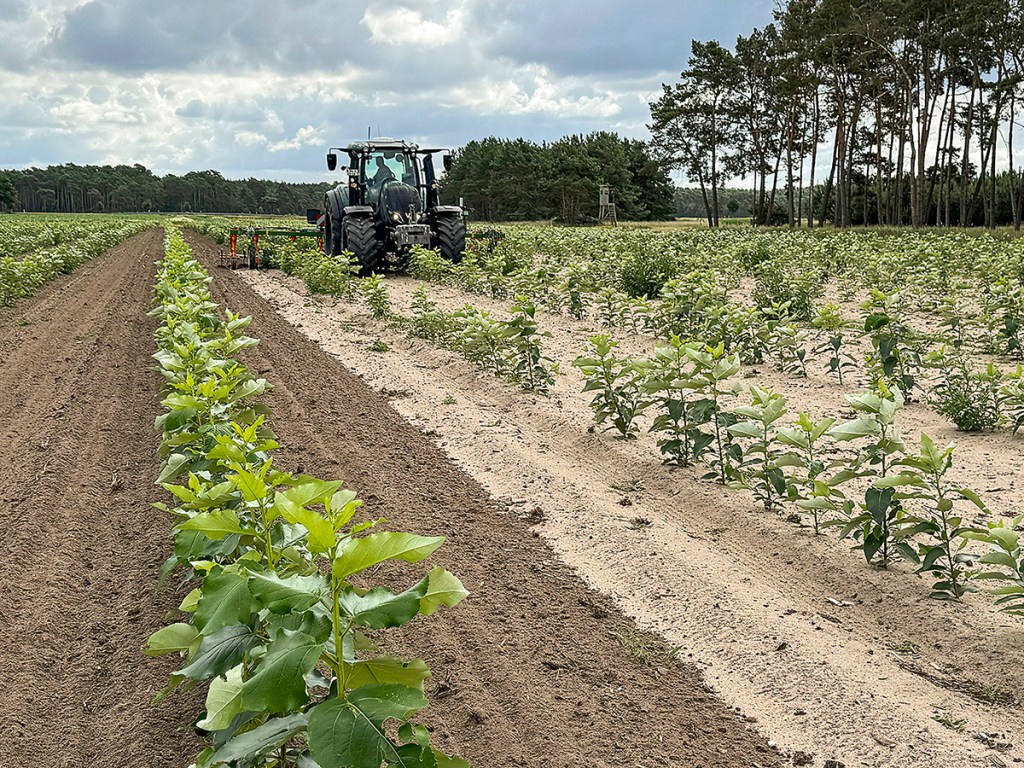
The tine is set to operate as close to the plants as possible, while the fingers push soil into the crop row, burying small weeds. Protective discs ensure the poplar sapling itself is not buried.
Contractor V.H.S. Dienstleistungen takes care of the mechanical weeding job, using the Energy Crops owned hoe but with their tractors and operators. “Setting up the hoe is a fairly complex job, so it doesn’t lend itself well to hiring out,” explains Dustin. “At the same time, we can run wide tyres and vary the track width as needed.”
This level of flexibility means the contractor can easily travel longer distances between fields. For the really long hauls, though, they plan to bring in a low-loader in future.
Shooting up
The hoe starts work at the end of April, with three passes planned 14 to 20 days apart. A final pass follows in early July, when a generous ground clearance is important. By the end of the year the poplars should stand about 2m tall. If they don’t, a pass with a narrow disc harrow between the rows may still be needed.
About 300ha were planted with poplars in 2025, bringing the total SRC area to about 2,500ha. As only the most recently planted plots need hoeing, the machine is busy but not overly stretched.
On our visit, some of the younger leaves showed clear frost damage, which is one of the few serious risks to the young plants alongside browsing by deer. Fertiliser isn’t required, as poplars fix nitrogen from the air through their bark. Disease and pests are generally not an issue, either.
Ideally, by year two the canopy is dense enough that hoeing between the rows is no longer necessary. Also, the crop is quite resilient by now. A real challenge for this location is the high population of birch trees in the vicinity, because birches self-seed between the poplar rows and complicate the harvesting operation.
Harvest and logistics
The first harvest comes after four years, so the 20-year contract covers at least four harvests. As the plant produces more side shoots after the first cut, then the following second and third harvests usually achieve the highest yields.
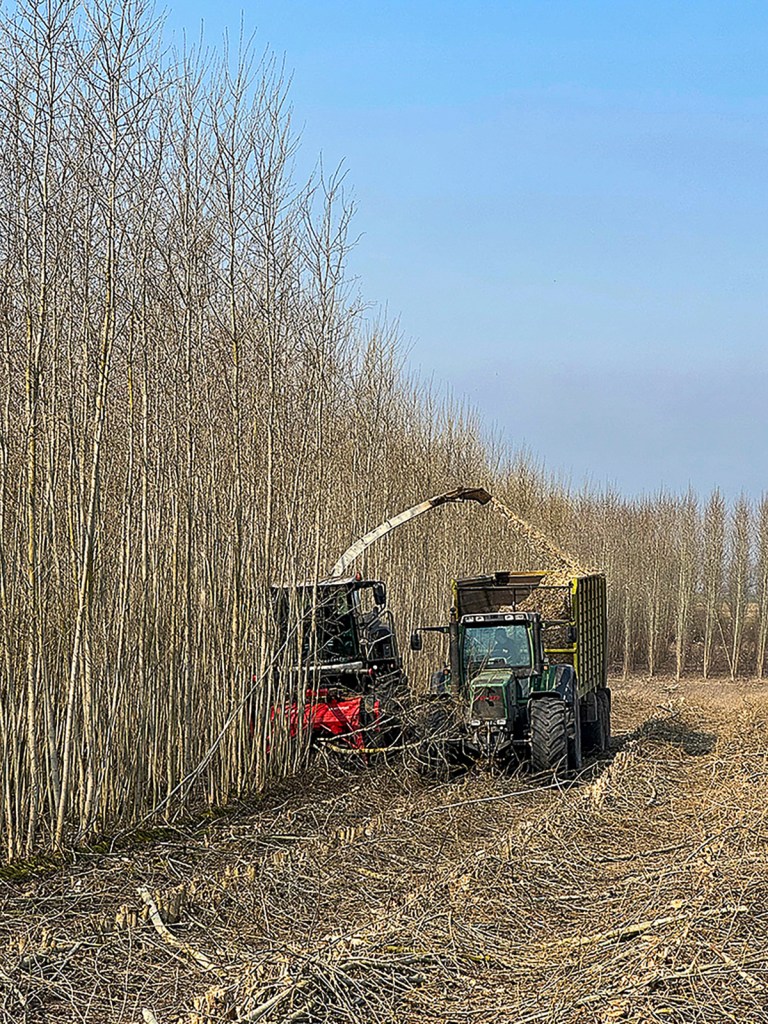
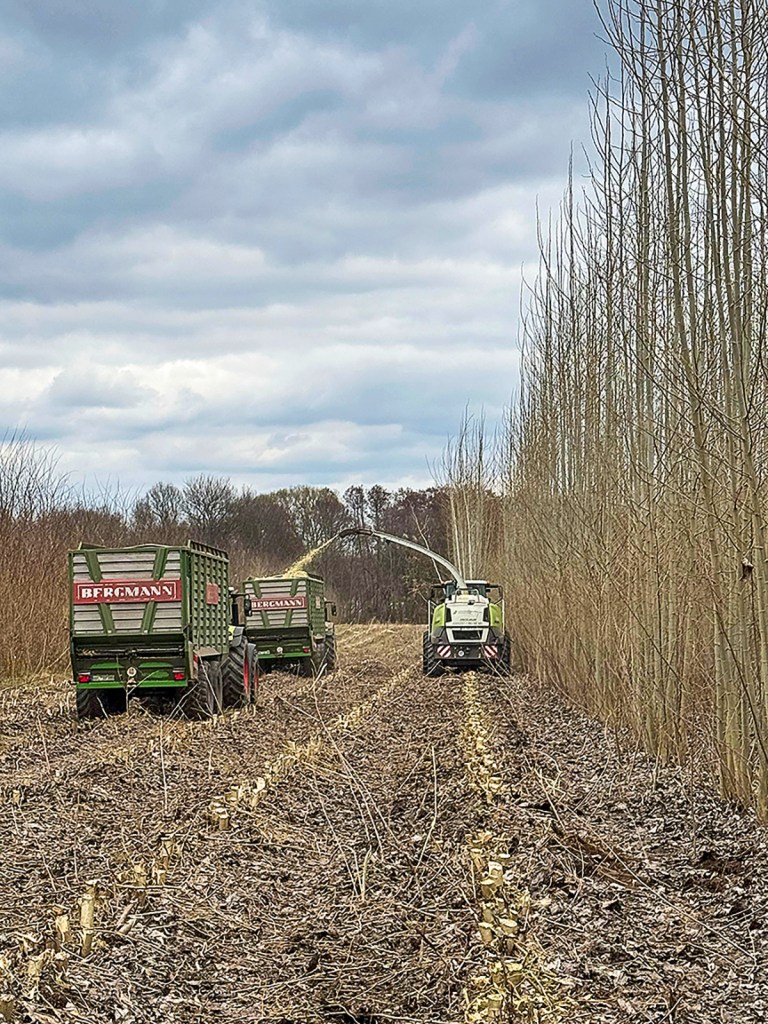
Five contracting firms handle the harvest between them, with several chipping chains processing about 500ha every year. Harvest runs from November to March, when dry matter content peaks at around 50%. The harvesters are specifically modified forage harvesters, reinforced for the punishing job and equipped with Wimatec or New Holland headers.
“Every contractor has their own take on the best chipping drum settings,” says Dustin.
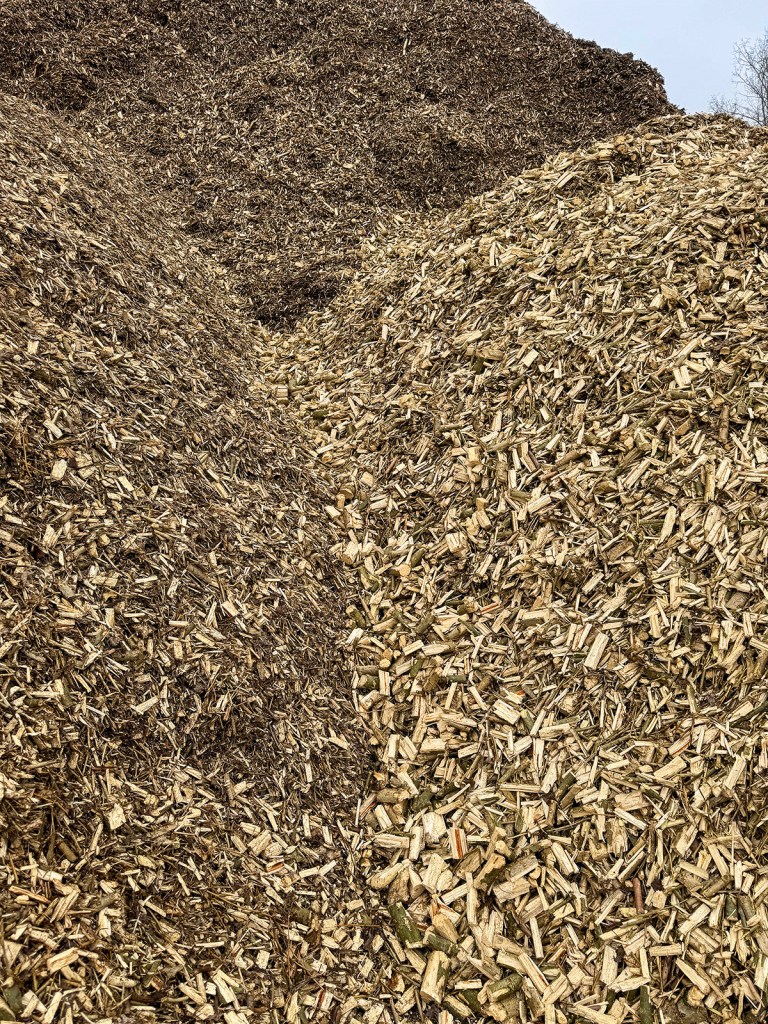
“We’re aiming for chips in the 5-10cm range, though processing 10-15cm thick poplar is hard on the kit.” The maximum harvesting speed is 5km/hr whereas downtime due to tyre damage from tough poplar stumps is a recurring headache. The material is carted with regular forage trailers.
Most chips are stored temporarily nearby, generally in rented clamps, before a lorry transports them to one of Energy Crops’ three main stores later in the year. From there, Energy Crops supplies the power station on a day-to-day basis. Some stores sit right on the waterway network, so barges take on some of the haulage, too.
Mix of various fuels
Energy Crops currently supplies a power station site that provides district heat and electricity to 30,000 Berlin households. The station fires 20,000t of SRC chips at 35% dry matter per year — this is about 15% of the annual total. Most of the fuel is, however, forest residue wood. “SRC chips carry a lot of moisture,” points out Dustin, “so blending them with other materials helps us to get a steady burn.”
The power station sites that are still in the planning phase are set to run on the same kind of mix: SRC, forest residues, landscape material, waste wood and other biomass.
Summary
Growing trees on arable land is nothing new. What makes Energy Crops stand out is the sheer scale of it. While modern machinery has made the work fairly easy, it’s the tillage job before planting and harvest logistics that pose the real challenges.
Financially, poplars stack up best against rye or maize silage. This applies particularly to less fertile soils. As Dustin puts it: “Being able to pencil in the returns 20 years out is, for us, a genuine advantage.”
One last key point to note: in Germany, these so-called agroforestry systems qualify for relatively attractive levels of grant funding, which varies by federal state.
Lucas Colsman
For more up-to-date farming news click here and subscribe now to profi and save.